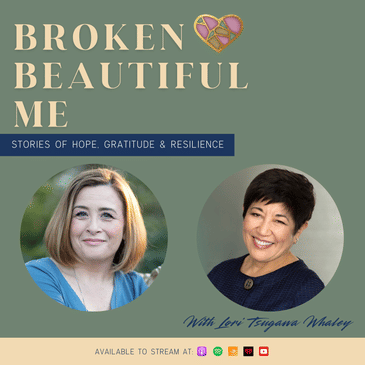
The Japanese Practice of Kintsugi With Lori Tsugawa, 2X TEDx Speaker, Author, & Japanese Business Strategist
In this captivating episode, we connect with Lori Tsugawa Whaley, a 2X TEDx speaker, author, and expert Japanese business strategist, to explore the ancient Japanese art of kintsugi—the practice of mending broken pottery with gold. As the third descendant of a Japanese warrior, Lori seamlessly weaves this powerful metaphor of healing broken pieces into her business coaching practice, offering profound insights into resilience and personal growth.
Lori shares how kintsugi represents the beauty of imperfection and the strength found in repairing what's broken—both in life and in business. She dives into how embracing adversity can lead to growth, teaching us that it's not about hiding the cracks but highlighting them, turning pain and hardship into something valuable. Throughout the conversation, Lori reflects on her personal journey, shaped by Japanese warrior principles, and offers practical advice for navigating life's challenges with grace, strength, and resilience.
In this episode, we discuss:
- The Japanese art of kintsugi and its symbolism of embracing imperfections to grow stronger.
- How Lori's cultural heritage and warrior lineage influence her approach to overcoming adversity.
- Practical tools and strategies for turning personal and professional challenges into opportunities for growth.
- Ways to integrate the principles of kintsugi into business and leadership practices.
This episode is a must-listen for anyone looking to find strength in adversity, whether you're navigating personal challenges or seeking new ways to build resilience and leadership in your professional life.
Connect with Lori Tsugawa Whaley:
- LinkedIn: Lori Tsugawa Whaley
- Website: LoriWhaley.com
Lori's wisdom offers practical techniques to apply the principles of kintsugi—both in your personal life and professional endeavors. If you're ready to embrace your own broken pieces and grow stronger from them, this episode will provide the inspiration and guidance you need.
------------------
Follow the Host, Kelly Buckley:
Stay connected with Kelly Buckley and join her journey of healing, resilience, and gratitude. Follow her on social media for more inspiring content, updates on future episodes, and insights on living a life full of hope and purpose.
- Website: kellybuckley.com
- Facebook: Kelly Buckley on Facebook
- Instagram: @KellyBuckleyOfficial
- LinkedIn: Kelly Buckley on LinkedIn
- Twitter: @KellyBuckley
- YouTube: Kelly Buckley on YouTube
If you enjoyed this episode, don't forget to subscribe to the podcast, share it with your friends and family, and leave a review. Your support helps spread the message of hope, resilience, and gratitude to more listeners around the world.
00:00:01
Hello, everyone,
00:00:02
and welcome to another
00:00:03
episode of Broken Beautiful Me,
00:00:06
Stories of Hope, Gratitude,
00:00:07
and Resilience.
00:00:09
I am so fortunate today to
00:00:11
have as my guest Lori Sugawa.
00:00:14
She helps business owners
00:00:16
achieve increased purpose, revenue,
00:00:19
and rapid growth using
00:00:21
ancient samurai wisdom,
00:00:23
which comes from her own family.
00:00:26
She attended Portland State University,
00:00:29
and she is a speaker, author,
00:00:31
and life coach.
00:00:33
I'm going to let her do a
00:00:34
little bit more of her own
00:00:36
introduction because her
00:00:37
background is amazing.
00:00:39
Lori, welcome to the show.
00:00:41
It's so wonderful to have you here.
00:00:45
Well, thank you so much, Kelly.
00:00:46
I'm so pleased and honored
00:00:48
to be here myself.
00:00:49
I would love to just give a
00:00:51
short introduction about myself.
00:00:53
Absolutely.
00:00:54
Sure.
00:00:55
My name is Lori Sagawa and
00:00:56
I'm a two time TEDx speaker
00:00:58
and a two time bestselling author.
00:01:00
I'm known as a samurai
00:01:02
strategist because as a
00:01:04
traumatic brain injury survivor,
00:01:06
I dug deeply into my own background,
00:01:09
my Japanese heritage,
00:01:10
which at that time I didn't
00:01:12
really embrace until I was
00:01:14
kind of faced with being...
00:01:17
with traumatic brain injury,
00:01:19
reading at a seventh grade
00:01:20
level and just having chronic pain.
00:01:24
But my life wasn't always
00:01:25
that easy because, you know, when I,
00:01:27
as I mentioned with
00:01:28
traumatic brain injury,
00:01:30
I was like a
00:01:32
non-functioning person
00:01:33
reading a seventh grade
00:01:34
level chronic pain.
00:01:35
And all I could do was maybe go to a, a,
00:01:38
an appointment and then drive home.
00:01:40
And sometimes if I drove too far,
00:01:41
I would get lost.
00:01:43
So it was not not a pleasant thing,
00:01:46
but I was determined to,
00:01:48
to overcome that situation
00:01:49
because who wants to be
00:01:50
reading in seventh grade
00:01:51
level and being like a non,
00:01:53
non-protective person so I
00:01:56
started researching my
00:01:57
background and then really
00:01:59
started embracing my
00:02:00
japanese heritage and then
00:02:03
it helped me face my fears
00:02:05
of doctors I just was I
00:02:07
just avoided them like the
00:02:08
plague you know they were
00:02:09
just because growing up we
00:02:11
had one country doctor that
00:02:13
had a shaky hand and he
00:02:14
took about ten at least ten
00:02:16
seconds to get a shot in us
00:02:18
and like oh do we remember that
00:02:21
But that was funny.
00:02:25
So what I do now is help
00:02:26
people through the ancient
00:02:28
principles of the Japanese culture.
00:02:31
And I read about Bushido,
00:02:34
the way the warrior
00:02:35
Ikigai, you know,
00:02:37
knowing your purpose of life.
00:02:38
Gambate or gambaru is never to give up.
00:02:41
And now I research more into kintsugi.
00:02:44
And I'm really excited
00:02:45
because I knew about it,
00:02:46
but I didn't really know
00:02:48
about how complex.
00:02:49
And it's not just something
00:02:51
that you just pick up and do.
00:02:53
It takes time.
00:02:54
It's a craft.
00:02:54
And in Japan,
00:02:56
they do honor their craftspeople.
00:02:57
So that's why I'm very
00:02:58
excited to talk about it.
00:03:00
How can Sugi, that ancient principle,
00:03:02
even though it's pottery or porcelain,
00:03:06
it can't apply to everybody's life.
00:03:09
I am so excited to talk to you about that.
00:03:11
Cause I mean,
00:03:12
you and I talked before we
00:03:13
started the show and you
00:03:15
know that my love of that, cause that's,
00:03:17
that's truly how I looked
00:03:19
at my own broken heart during times of,
00:03:21
of struggle in my own life.
00:03:22
So I can't wait to hear your wisdom, um,
00:03:26
about that.
00:03:27
Could you go back to,
00:03:28
you talked a little bit about, um,
00:03:31
the code of Bushido, um,
00:03:38
And then the third one was,
00:03:42
can you just tell me like, just in a,
00:03:44
in a couple of quick sentences, what the,
00:03:47
the basis of what those
00:03:48
three principles would be about?
00:03:50
Sure.
00:03:50
I like to start with ikigai
00:03:52
because that is your purpose in life.
00:03:55
And if one doesn't know
00:03:56
their purpose in life,
00:03:57
they walk through life aimless.
00:03:59
And I found that out when I
00:04:00
worked in the prison with women.
00:04:03
And the code of bushido is
00:04:04
bushi is warrior, do is a way.
00:04:06
So it's the way of the warrior.
00:04:08
There are seven principles
00:04:09
that they live by.
00:04:09
It was courage, integrity, benevolence,
00:04:12
respect, honesty, honor, and loyalty.
00:04:14
And they pledged their lives
00:04:16
and their sacred honor to
00:04:17
defend the code.
00:04:18
They're
00:04:19
and that could be their daimyo,
00:04:21
their family, their village.
00:04:24
They took that very seriously.
00:04:26
And the last is gambaru,
00:04:28
and that is never give up.
00:04:30
Try your hardest, do your best,
00:04:31
never give up, and go for a pro.
00:04:33
But it also means that you
00:04:35
truly have not finished
00:04:37
until you've completed your task.
00:04:39
You could start on a goal,
00:04:41
but if you don't finish it,
00:04:42
then it's really, they say, keep going,
00:04:45
keep going.
00:04:45
That's what they did.
00:04:46
to encourage each other for, you know,
00:04:48
like tests in Japan for exams, games,
00:04:52
but they also did that
00:04:53
during the earthquake and tsunami.
00:04:55
Oh my goodness.
00:04:58
Oh, my goodness.
00:04:59
So reconnecting like you.
00:05:01
And I mean, I'm hearing you.
00:05:02
You drop all these little
00:05:03
nuggets of wisdom as we're
00:05:05
as we're chatting.
00:05:08
And like to hear you worked
00:05:09
with with women in in prison.
00:05:13
That must have been an
00:05:14
incredible experience for
00:05:15
you teaching them the
00:05:17
wisdom of the samurai.
00:05:20
it was I actually started
00:05:21
out working not working but
00:05:24
volunteering and then
00:05:25
joining their toastmaster
00:05:26
group and then one of the
00:05:29
staff members said lori we
00:05:30
really really want to hear
00:05:32
it well I'll find a place
00:05:33
for you and so she did and
00:05:34
then it just kind of came
00:05:36
at a time when I was
00:05:38
recovering from traumatic
00:05:39
brain injury and so it was
00:05:41
it was very therapeutic for
00:05:42
me because I understood now
00:05:45
what struggling meant.
00:05:46
Because I mean, life was hard at times,
00:05:49
but not that hard.
00:05:51
So it gave me a lot more
00:05:52
empathy and compassion for people.
00:05:55
And just realizing that people are people.
00:05:58
Had this not happened to me,
00:05:59
I don't think I would have
00:06:00
been there because I kind of
00:06:02
you know, didn't want to go there,
00:06:04
but it's really interesting to,
00:06:05
to actually go there and you really,
00:06:08
it really is prison and you
00:06:09
have to go through all
00:06:10
those doors and they slam
00:06:11
behind you probably about
00:06:13
six or seven doors and
00:06:15
seeing the officers and the,
00:06:17
and the women are there.
00:06:18
It's not a threat because
00:06:19
you're in a room and if
00:06:20
there's any problem,
00:06:23
then the guards will come
00:06:24
in or I can call for a guard,
00:06:26
but I did not because my
00:06:27
class was elective.
00:06:30
Yeah,
00:06:31
and then showing fellow humans kind
00:06:37
of what you've learned and
00:06:38
how you've learned from
00:06:39
your own struggle.
00:06:41
So I want our listeners to understand,
00:06:44
you just didn't research
00:06:46
about being a samurai.
00:06:48
You traced back your family lineage.
00:06:51
So tell our audience about that,
00:06:52
because this is incredible to me.
00:06:55
Well, as I was researching, I started...
00:06:58
learning more about the
00:06:59
samurai and I thought oh
00:07:01
this is really interesting
00:07:02
because a lot of the what
00:07:04
people hear about the
00:07:05
samurai are their battles
00:07:07
and they were fierce
00:07:09
awesome warriors but what I
00:07:11
concentrated on was the
00:07:13
right side of what they did
00:07:14
they were the poets authors
00:07:16
they did tea ceremony they um
00:07:20
were the scholars.
00:07:21
And actually,
00:07:22
when I started researching about the,
00:07:24
they call them Kamons, they're crests.
00:07:27
And I'll show you our family crest,
00:07:28
which back in the eighties,
00:07:31
my husband and I went to
00:07:33
Japan and our family gave us the,
00:07:36
you know, a paper copy of our crest.
00:07:38
And I thought, oh, thank you very much.
00:07:40
And our family tree,
00:07:41
but it didn't mean much to
00:07:42
me until I connected the
00:07:44
dots as I was researching.
00:07:46
And so, oh, good.
00:07:48
You can't see it.
00:07:49
Oh, yeah, that's a beautiful view of it.
00:07:51
It's gorgeous.
00:07:52
And up at the top is our stylized sword.
00:07:56
So there's three of those.
00:07:58
And then on the other side
00:07:59
of them are three leaves
00:08:00
that look like hearts,
00:08:01
but they're from the Katabami plant.
00:08:03
And it actually says that
00:08:04
this is one of the crests
00:08:05
of feudal Japan of the samurai.
00:08:09
So I thought, and I knew,
00:08:11
I kind of felt like I was
00:08:13
samurai after I saw the movie.
00:08:15
And I asked my dad, and he goes, well,
00:08:16
I think there's some.
00:08:17
But after receiving this from our family,
00:08:22
researching is and finding
00:08:24
out that yes indeed this is
00:08:25
a samurai crest but other
00:08:27
families shared that same
00:08:29
crest it's not like we had
00:08:30
our own self our own crest
00:08:33
it was like a plan that was
00:08:35
and our family is from
00:08:37
shikoku japan that's one of
00:08:39
the smallest four main
00:08:40
islands and we went there a
00:08:43
couple times in our in our
00:08:44
travels I love shikoku I go back again
00:08:51
That's on my bucket list to go to Japan.
00:08:53
I hope I get to do that.
00:08:55
Yeah.
00:08:58
So you traced back your family history.
00:09:01
You've used that in your own self-healing.
00:09:04
And then in the most
00:09:05
beautiful and selfless act,
00:09:06
you turn around and you say, okay,
00:09:07
how can I help other people with this?
00:09:10
I know,
00:09:10
because I really believe that it can help,
00:09:13
you know, Ikigai, Ganbaru,
00:09:16
and the Kotobushiro,
00:09:18
because it's like you find
00:09:20
out who you are,
00:09:21
then you have your moral framework,
00:09:22
I call them, you know,
00:09:24
like where you stand,
00:09:26
put your stake in the ground.
00:09:28
And then Ganbaru is never to give up,
00:09:30
because had I given up in
00:09:32
all those situations,
00:09:34
appointments, probably hundreds,
00:09:37
if not a thousand,
00:09:38
because I did like six
00:09:40
years of speech pathology
00:09:44
with one and then about two
00:09:45
years with another one
00:09:46
because I had a different
00:09:47
issue that she did not cover physiatrist.
00:09:51
you know, physical therapy, neuroscience.
00:09:54
I mean,
00:09:55
I just went through everything
00:09:56
because I didn't want to be
00:09:57
in that condition.
00:10:00
You know,
00:10:00
who wants to be in that condition?
00:10:01
It was midlife for me,
00:10:03
and I just didn't want to stay that way.
00:10:06
I didn't want to be a burden to my husband,
00:10:08
who was just about ready to retire.
00:10:10
And then I knew that I was
00:10:11
going to have grandchildren.
00:10:14
And this winter, right after Christmas,
00:10:18
we're going to go for about
00:10:19
a week and come back right
00:10:21
after New Year's Day too.
00:10:23
Because my younger,
00:10:25
only grandson kept saying to us, he goes,
00:10:29
oh, I'd really like to go to Japan.
00:10:30
And grandma, you'd be a great guide.
00:10:33
And so I just,
00:10:34
he's been saying that for years.
00:10:36
And then finally, I just told him, well,
00:10:37
Kenji, you know, it could happen.
00:10:39
Just pray about it.
00:10:40
And then about five years later,
00:10:42
we're having dinner with,
00:10:43
you know, my son and his wife.
00:10:45
And we started talking and
00:10:47
we just kind of put it together.
00:10:48
And she goes,
00:10:49
this will be a really good
00:10:50
time because they're in different grades,
00:10:52
doing different things.
00:10:53
And so I'm really excited to
00:10:55
be taking them.
00:10:56
They are really excited.
00:10:57
They have Duolingo on their
00:10:58
phone and they told us what
00:11:00
they want to do.
00:11:01
Of course, they want to go to soccer.
00:11:02
They're younger.
00:11:03
And we told him about seeing Himeji,
00:11:07
which is the largest castle in Japan.
00:11:11
It's very well preserved.
00:11:13
And it's huge.
00:11:14
They had three moats.
00:11:15
Now there's only one.
00:11:16
So that's the one place I said,
00:11:18
we really need to go on that.
00:11:19
Get on the Shinkansen.
00:11:20
We can eat food all we want on the train.
00:11:22
You can't just eat anywhere
00:11:26
in Japan unless you're at a
00:11:28
stall or someplace like that.
00:11:31
they have certain rules and
00:11:33
they're very respectful.
00:11:35
You can't just trash.
00:11:36
And it's just a different way of life.
00:11:39
And I love to introduce people to Japan.
00:11:42
I've taken two groups to Japan.
00:11:45
This will be my third in twenty five.
00:11:47
Oh, that's beautiful.
00:11:48
And for your grandchildren
00:11:51
to learn from you about their heritage.
00:11:54
Oh,
00:11:55
what an experience for them that they
00:11:57
will carry with them forever.
00:11:59
They're really excited.
00:12:00
We're excited too.
00:12:03
Especially the boy wanted to do Osaka.
00:12:05
And I said, no,
00:12:06
we're not going to do that.
00:12:07
We're just going to go to
00:12:08
all the boring museums.
00:12:09
And he kind of looked at me like that.
00:12:14
I go, oh, you know, I'm kidding you.
00:12:16
Lori,
00:12:17
you just don't seem like that kind of
00:12:18
grandma.
00:12:18
You seem like the fun grandma.
00:12:21
We are fun grandparents.
00:12:23
We have a lot of fun with them.
00:12:24
That is something to cherish
00:12:26
and enjoy for sure.
00:12:28
And then, so you, you've turned this into,
00:12:33
you know,
00:12:33
not only giving back as we
00:12:35
talked about with,
00:12:36
with helping women in the prison system,
00:12:38
but you've turned in this
00:12:40
into a business that you're
00:12:42
helping people in business
00:12:44
use this beautiful code of
00:12:47
the samurai to be better leaders,
00:12:51
to be better servants to the public.
00:12:54
And I love what you're doing with that.
00:12:57
Explain to our audience how
00:12:59
you then apply this in the
00:13:02
business sense.
00:13:03
In the business sense is what we are.
00:13:06
You can't separate your
00:13:08
private life from your business life.
00:13:10
And so I just encourage
00:13:12
people and I encourage
00:13:14
businesses to adopt these principles,
00:13:17
even if it's one, any of those,
00:13:19
because those principles make,
00:13:22
build character.
00:13:24
And we all love to work and
00:13:27
have relationships with
00:13:29
people that we trust and know and like.
00:13:31
And I gave an example as one
00:13:35
time I was in a business
00:13:37
and I saw someone stealing,
00:13:41
and I actually told the
00:13:43
owner about it and he
00:13:44
didn't appreciate that.
00:13:45
And so I was
00:13:46
You know, just let go over.
00:13:48
We need to downsize.
00:13:50
And so I thought, well,
00:13:51
that's OK if they don't.
00:13:53
And then it wasn't much
00:13:54
later when they had to call
00:13:55
in a consultant and said, you know,
00:13:58
why are we not making money?
00:14:00
And within an hour, he says it's her.
00:14:03
And she's the one that I
00:14:04
reported to him about.
00:14:06
I mean, that took guts to tell him.
00:14:08
And I was rejected, but that's OK.
00:14:11
I thought, you know, well,
00:14:12
there's a better place for me.
00:14:13
I was working at that time.
00:14:15
So that's how I help people
00:14:17
and help businesses is to
00:14:18
realize that their culture
00:14:21
will be enhanced when
00:14:23
people find their ikigai,
00:14:25
they're working and serving in their lane,
00:14:30
shall we say, and knowing their purpose.
00:14:33
They don't have to adopt all of them,
00:14:35
but just even if they have one,
00:14:36
courage and honesty,
00:14:37
that would really turn a
00:14:40
business around because
00:14:41
businesses suffer from theft.
00:14:45
And we all know that.
00:14:46
And some people say, oh, well,
00:14:47
it's just a pen.
00:14:48
Well, you know,
00:14:49
if you have a hundred employees,
00:14:51
a hundred pens or a hundred this or that,
00:14:53
that makes a difference.
00:14:54
And it brings morale down, I believe,
00:14:56
because they think, well,
00:14:57
there's no structure here.
00:15:01
Anything goes.
00:15:03
Well, and I think too, you know,
00:15:06
you see there's different
00:15:08
kinds of situations like
00:15:09
that you see in an employee situation.
00:15:11
Like today with social media
00:15:13
and everybody has the
00:15:14
access to the entire planet
00:15:16
right in their pocket on their phone.
00:15:19
that they can sometimes be
00:15:20
distracted from their work.
00:15:22
Um, and that in itself is,
00:15:24
is a way that they're not
00:15:26
respecting the employer.
00:15:27
However, and however, as,
00:15:30
cause I'm a small business owner as well.
00:15:33
And we,
00:15:34
my husband and I are both entrepreneurs.
00:15:36
Um, and,
00:15:37
People model what they see, right?
00:15:41
And so your work with
00:15:42
leadership is so important
00:15:44
because people model what they see.
00:15:47
So if they see a leader who is kind,
00:15:50
who is honest, who is purpose-driven,
00:15:55
and they set that example,
00:15:57
that's the kind of employees they're
00:15:59
If they choose to stay in that environment,
00:16:01
they will have to rise to
00:16:02
that occasion or they won't.
00:16:04
Right.
00:16:06
So it's your concepts that you share.
00:16:10
I just think, you know,
00:16:12
I talk to my husband about
00:16:13
them because I think
00:16:14
they're powerful for leaders.
00:16:17
Don't you think, too,
00:16:18
that the world is kind of
00:16:20
ready for for that kind of
00:16:22
approach to business and life,
00:16:24
that we need to get back to
00:16:25
those that kind of worldview?
00:16:28
Right.
00:16:29
It needs to kind of swing back.
00:16:30
We need to start being kind again.
00:16:32
And I think I think we're at
00:16:35
kind of the tipping point for that.
00:16:37
Do you think?
00:16:38
I believe so, too,
00:16:39
because the world is just
00:16:41
just has gone gone awry, shall we say.
00:16:44
And I believe that going back and forth,
00:16:47
and that's why I point
00:16:48
people towards Japan and
00:16:50
the principles that they live by.
00:16:52
You will not see writing on the wall.
00:16:55
The kids in their schools
00:16:57
actually are the janitors.
00:16:59
They don't write on the
00:16:59
walls because they'd have to clean it up.
00:17:01
They serve each other.
00:17:03
That's a social practice
00:17:06
that they're demonstrating
00:17:07
is that social
00:17:09
responsibility and then
00:17:10
also just serving.
00:17:12
And that's part of...
00:17:13
well, that's part of Ikigai in Okinawa.
00:17:16
And I love teaching about that.
00:17:18
I'm going to be having a
00:17:19
masterclass about that next
00:17:21
month because I was
00:17:24
challenged in one of my
00:17:26
things is what about
00:17:27
teaching younger kids?
00:17:28
And I said, you know, that's so needed.
00:17:32
Imagine if kids find out
00:17:35
what way they should go early in life,
00:17:38
that will make such a difference.
00:17:40
And I'm looking into that and
00:17:43
taking my materials, like,
00:17:44
especially like Ikigai, Kodobushido,
00:17:46
all of those and write it
00:17:49
in a more like junior high
00:17:51
and high school level.
00:17:53
Oh my gosh, that would be beautiful.
00:17:56
And, and especially, you know,
00:17:58
I was recently talking to someone,
00:18:00
we were talking about young
00:18:02
people post COVID and how, you know,
00:18:07
socially they were isolated
00:18:08
for such a period of time.
00:18:10
And, and,
00:18:11
You know how kind of this
00:18:13
the structure and the
00:18:15
foundation that they
00:18:16
usually build for
00:18:17
themselves through
00:18:18
community was lost during
00:18:20
that period of time and how
00:18:21
they're kind of rushing now
00:18:23
to try to catch up.
00:18:25
Even my own son who I mean,
00:18:27
he's he's off working now
00:18:29
and he's all grown up.
00:18:30
But when he was in
00:18:31
university during covid.
00:18:33
And, you know,
00:18:34
his classroom was his bedroom.
00:18:37
And that's just not good for people,
00:18:39
right?
00:18:39
Like you're supposed to be
00:18:40
out and meeting people in
00:18:42
your community and helping
00:18:44
other people and having
00:18:45
other people help you and
00:18:46
that give and take of society.
00:18:49
So I'm sure that a message
00:18:51
to the youth would be well
00:18:52
received for sure.
00:18:53
I think so too.
00:18:54
And I forgot to mention that
00:18:56
I was involved with the
00:18:57
Chamber of Commerce and
00:18:59
during COVID it went like less than half.
00:19:02
And she was kind of called
00:19:04
out from retirement and
00:19:05
they wanted her to come back.
00:19:06
And she goes, I don't know what to do.
00:19:08
And I said, well, I'll help you.
00:19:09
So we're working together.
00:19:11
I'll be speaking there next
00:19:12
year and talking about how you can,
00:19:15
we can use these,
00:19:16
these principles to help
00:19:18
build that business back up again,
00:19:20
because it was very viable,
00:19:21
for a little community.
00:19:24
And now they have, she said during COVID,
00:19:28
nobody was billed and,
00:19:29
So now people say, oh yeah, I need to,
00:19:32
you know,
00:19:32
pay a few years of back due or
00:19:35
whatever back dues.
00:19:38
And so that's, what's happening.
00:19:39
And I love seeing things,
00:19:41
businesses and organization, you know,
00:19:43
like helping in the prison system,
00:19:45
because I would tell them, you know,
00:19:47
you deserve a better life.
00:19:49
Yes.
00:19:49
You have your,
00:19:50
your head covered and you
00:19:52
have food on the table.
00:19:53
but you know, you are,
00:19:55
everybody is meant to live
00:19:57
a better life than this.
00:19:58
And so that's what I would
00:20:01
steer them towards.
00:20:03
And I've had programs like a
00:20:04
reading program and just
00:20:06
teaching them about the Kota Bushido.
00:20:08
And we'd actually went through our book,
00:20:10
my book, and I had it, uh,
00:20:13
they copied it for me for
00:20:14
the people in the prison.
00:20:15
And the women love getting certificates.
00:20:18
I would give them certificates too.
00:20:19
And just seeing that anything,
00:20:22
my mom used to tell me
00:20:23
there's always a way,
00:20:24
there's always a way.
00:20:25
And so I knew that when I
00:20:28
first started learning
00:20:29
about traumatic brain
00:20:30
injury and what I had,
00:20:33
No one at that time,
00:20:34
no one had many answers.
00:20:36
It was oh five and oh seven.
00:20:37
They were starting to learn about it.
00:20:39
But now they're finding out
00:20:40
that the brain is can and
00:20:42
does make new pathways.
00:20:44
And just because you're at one position,
00:20:46
you don't have to stay there.
00:20:48
And the world isn't lost.
00:20:50
We live in a wonderful world
00:20:52
right now where there are
00:20:53
discoveries all the time.
00:20:55
And I was really happy.
00:20:57
And I even did a brain scan
00:20:58
with Dr. Amen and just all
00:21:00
these things to help me.
00:21:04
And March is,
00:21:06
I think it's the National
00:21:07
Brain Injury Month.
00:21:09
You said March is that?
00:21:11
March.
00:21:11
March.
00:21:12
We'll have to keep that in
00:21:13
mind because there's so
00:21:14
many people who deal with
00:21:16
traumatic brain injury.
00:21:17
And it's good that you are
00:21:21
out there talking about it,
00:21:23
that there are new things
00:21:25
on the horizon medically,
00:21:27
and that you are giving
00:21:28
this message of not giving
00:21:29
up because it can be a very
00:21:32
isolating experience, I imagine.
00:21:34
It was.
00:21:35
It was at times because a
00:21:37
lot of people didn't,
00:21:38
especially some doctors,
00:21:40
when my ophthalmologist
00:21:43
told me that there was no
00:21:44
correlation between reading
00:21:46
at a seventh grade level
00:21:47
and the accident.
00:21:49
And I said, okay, thank you.
00:21:51
So I thought I'm different.
00:21:53
Had I taken his advice,
00:21:54
I'd be way back then,
00:21:58
now like I was back then,
00:21:59
reading at a seventh grade
00:22:00
level and being not very productive.
00:22:03
So I said, okay, thank you.
00:22:05
And my speech pathologist
00:22:06
steered me towards a vision
00:22:08
ophthalmologist that could help me.
00:22:10
And I was with him about two, three years.
00:22:13
Yep.
00:22:15
Yeah, that is, you know,
00:22:18
having the right practitioners.
00:22:20
And like you said,
00:22:21
having a speech language
00:22:22
pathologist who sounds like
00:22:24
kind of a champion for you,
00:22:26
who wanted the best for you,
00:22:27
that makes all the
00:22:28
difference in the world.
00:22:30
So you,
00:22:31
before you even started your research,
00:22:33
you were kind of living the
00:22:34
life of a samurai in the
00:22:35
fact that you never gave up.
00:22:37
You always kept going, right?
00:22:39
So it's ingrained in you on
00:22:41
a cellular level.
00:22:42
You are a samurai.
00:22:44
from our family background
00:22:47
of being farmers.
00:22:48
You know, we couldn't quit.
00:22:50
At the end of the day, if there was,
00:22:51
everybody went home,
00:22:52
it was raining and the rose
00:22:53
weren't picked,
00:22:54
they'd send us out there because they say,
00:22:56
if those berries rot,
00:22:57
it could rot the whole rose.
00:22:58
So we'd go out there wet
00:23:00
sleeves and raincoats.
00:23:02
And it's like, oh,
00:23:03
I used to think this is not my life,
00:23:06
but it taught me a lot.
00:23:09
My sisters loved it.
00:23:10
They loved getting dirty,
00:23:11
chasing each other around
00:23:12
with the pickups and the
00:23:15
motorcycles and changing
00:23:17
the irrigation and having
00:23:18
it go all over them.
00:23:20
They loved that.
00:23:21
Swimming in the mud.
00:23:22
Oh, my gosh.
00:23:24
They called me Miss Priss.
00:23:30
You were swimming in the mud with them?
00:23:33
Pardon?
00:23:34
You weren't swimming in the
00:23:35
mud with them then?
00:23:36
Oh, not me.
00:23:43
I took a picture of them.
00:23:45
That's great, Lori.
00:23:47
I want to switch directions a little bit.
00:23:50
And we had talked about Kintsugi.
00:23:54
And, you know,
00:23:56
you know that I talk a lot
00:23:58
about resilience.
00:24:00
And I know that, you know,
00:24:01
you yourself have lived
00:24:03
such a resilient life.
00:24:06
Can you talk to me about the
00:24:08
meaning and the principles
00:24:10
that are behind the practice of kintsugi?
00:24:13
I would like to,
00:24:14
could I read that one quote?
00:24:18
Absolutely.
00:24:18
Okay.
00:24:19
We're stronger in the places
00:24:21
that we've never been broken.
00:24:23
That's Ernest Hemingway.
00:24:24
And never be ashamed about
00:24:26
being broken because
00:24:27
strength is nothing but
00:24:29
pain that's been repaired.
00:24:30
Trent Sheldon.
00:24:32
And so Kintsugi is keen is
00:24:33
gold and Tsugi is repairing.
00:24:35
So it's about the art of repairing.
00:24:38
And it goes back over five hundred years.
00:24:40
And they they believe that.
00:24:44
broken is not the end of it.
00:24:46
It can be repaired.
00:24:47
And that's kind of like wabi-sabi,
00:24:49
the essence of life and how
00:24:50
you continue preparing,
00:24:53
you continue growing.
00:24:55
And that's what happened in
00:24:56
my life is that I was
00:24:57
broken and I had to put the
00:24:59
pieces back together like Humpty Dumpty,
00:25:02
like I shared with you.
00:25:03
But it's like just because it's broken,
00:25:06
that doesn't mean you leave it broken.
00:25:08
You fix it, you repair it,
00:25:10
but you do it beautifully.
00:25:12
And it's not just putting it
00:25:13
together with almond glue
00:25:15
or hot glue or whatever.
00:25:16
They make a special glue and
00:25:18
then they put the gold in
00:25:19
it to make it look more
00:25:22
beautiful being repaired.
00:25:26
objects that have been
00:25:26
repaired are actually more
00:25:28
beautiful once they're repaired.
00:25:31
And I like that because it's
00:25:32
like anybody's life.
00:25:34
When something happens, tragedy happens,
00:25:36
you can make it better.
00:25:38
You can learn from it.
00:25:39
You can share with people
00:25:40
who can help other people.
00:25:41
And I've been able to help a
00:25:42
lot of people and even
00:25:44
people that are starting to
00:25:46
go down that slippery slide
00:25:48
of all cyber dementia.
00:25:50
You know,
00:25:50
I tell them about speech pathologists,
00:25:53
get it, get diagnosed.
00:25:56
There's a game called, not a game,
00:25:59
it's an exercise that you
00:26:00
could put on your phone or
00:26:02
your iPads work best on the
00:26:03
iPads called elevate.
00:26:05
And it helps you with your
00:26:06
speech or the math here.
00:26:08
all of those things.
00:26:09
And it helps keep one's mind
00:26:11
sharp because it's, our brains are like,
00:26:14
they are an organ.
00:26:15
And once you, they're also,
00:26:19
there's plasticity to it.
00:26:21
The inside of your skull, I mean,
00:26:23
the exterior skull is very hard,
00:26:25
but the inside is not so, not so hard.
00:26:30
So that's when athletes,
00:26:32
people that get into accidents like I did,
00:26:34
I was rear-ended.
00:26:35
That's why that happens.
00:26:38
Twelve cords that go up and
00:26:39
down your spine and four of
00:26:40
them having to do with your vision.
00:26:44
And so that's where I feel
00:26:46
that the ophthalmologist was not correct.
00:26:50
I mean,
00:26:50
you don't just go from being a
00:26:52
college graduate to reading
00:26:54
at a seventh grade level
00:26:55
within a couple of weeks for no reason.
00:26:57
I mean, it just doesn't happen that way.
00:26:59
So I sought answers and I
00:27:01
found so many answers and
00:27:03
so many good practitioners
00:27:05
out there that it gave me more hope,
00:27:08
shall we say,
00:27:09
for the medical profession
00:27:11
that there are good
00:27:14
practitioners out there.
00:27:15
You just need to find them
00:27:16
and find the ones that are open.
00:27:19
credible and uh I just it
00:27:22
was it was a journey it was
00:27:23
really a journey and I
00:27:25
found some therapists that
00:27:26
I didn't continue with
00:27:28
because they weren't being
00:27:29
they weren't as helpful as
00:27:31
others could have been or
00:27:33
others were for me so
00:27:34
that's what I did I did a lot of
00:27:37
Just so much.
00:27:38
I even tried acupuncture and
00:27:40
I couldn't do that.
00:27:40
It's like, oh, I can't do needles.
00:27:43
But I did do some other...
00:27:44
The neurologists are good.
00:27:46
They're good for a lot of things.
00:27:47
But each person or...
00:27:52
physician, they have their own specialty.
00:27:57
And I was so glad that the
00:27:59
physiatrist that I went to,
00:28:00
and prior to that,
00:28:02
I didn't even know what a
00:28:02
physiatrist was.
00:28:04
And he sent me to my...
00:28:07
general practitioner who
00:28:09
practiced functional
00:28:11
medicine sent me to a
00:28:12
physiatrist and he goes, he's the best.
00:28:14
And I said, oh, okay.
00:28:16
So I had to look it up at home,
00:28:18
what a physiatrist was.
00:28:20
And then he also sent me to
00:28:21
a physical therapist and he
00:28:23
would ask me questions.
00:28:25
And after a few months, he says,
00:28:27
are you still having issues
00:28:28
with your thinking, your brain?
00:28:30
I go, oh, I do.
00:28:31
So he didn't want to pour it
00:28:32
all on me at one time, which was good.
00:28:34
And then I went to a speech
00:28:36
pathologist and I thought, well,
00:28:37
there's nothing really.
00:28:39
I spoke OK, but it was for the brain.
00:28:42
And so speech pathologists
00:28:44
take two venues.
00:28:46
They could either go the
00:28:47
speech or they can work on
00:28:50
cognitive rehabilitation.
00:28:51
And that's what she did.
00:28:53
So I just was so fortunate
00:28:55
to find really great
00:28:57
practitioners that could help me.
00:29:00
That is wonderful.
00:29:01
And so that was the part of
00:29:03
you putting yourself back together again,
00:29:06
right?
00:29:10
It is.
00:29:11
I mean, it,
00:29:11
it takes a lot of life to get
00:29:13
us to the place that we are.
00:29:15
And so,
00:29:16
so it only goes to figure that when
00:29:18
bad things happen,
00:29:19
it's going to take us a
00:29:20
little while to get back on
00:29:21
track and put ourselves back together.
00:29:23
Yeah.
00:29:25
And every little piece, it's never, I mean,
00:29:28
from my experience, I feel like, yeah,
00:29:30
I put myself back together.
00:29:32
I'm not quite the same.
00:29:34
And that's okay.
00:29:35
That's okay, right?
00:29:36
It's okay not to be quite the same.
00:29:38
It's okay to embrace what
00:29:41
has happened to us and that
00:29:42
it's made us more beautiful,
00:29:44
just like the porcelain.
00:29:47
Yes, just like the porcelain.
00:29:49
It really is.
00:29:50
And, you know,
00:29:51
just being broken doesn't
00:29:53
mean that you're,
00:29:55
irreparable,
00:29:56
it means that you're different.
00:29:57
And I am different.
00:29:58
I know I'm different.
00:30:00
Some things are harder for me,
00:30:01
but for the most part, I'm functioning.
00:30:05
I'm a functioning, productive citizen.
00:30:07
And that's what I encourage other,
00:30:09
especially like in the prison.
00:30:10
I said, you know,
00:30:10
you have life ahead of you.
00:30:12
There's so many,
00:30:13
even right there in the prison,
00:30:15
there's so many
00:30:16
Things that you can do,
00:30:17
you can get your GED,
00:30:18
you can go to the gym and work out.
00:30:20
You can even earn a little money, not much,
00:30:23
but you can earn money
00:30:24
while you're incarcerated
00:30:26
and join different classes.
00:30:30
There's so much that can be done.
00:30:32
You know,
00:30:32
like Viktor Frankl's book I read
00:30:35
during my recovery period.
00:30:37
recovery time a man's search
00:30:39
for meaning and it was like
00:30:41
that was one of the most
00:30:42
eye-opening books I've ever
00:30:43
read very short and
00:30:46
translated in many
00:30:47
languages but he was a
00:30:48
holocaust survivor
00:30:50
determined to survive so
00:30:53
that he could tell people
00:30:54
what happened and that it
00:30:56
really did happen and he he
00:30:58
his story is just amazing
00:31:00
there's so many stories like that
00:31:03
There is.
00:31:03
And I mean,
00:31:05
you really downplay yourself
00:31:06
when you say I'm a
00:31:07
functioning human being.
00:31:08
You've done so much to help other people.
00:31:11
I think you're a little bit
00:31:12
more than just a functioning human being.
00:31:15
I just got to give a shout
00:31:16
out to you there.
00:31:16
So I'm not going to let you
00:31:18
hide your light under a bushel.
00:31:22
So how, for our listeners,
00:31:25
so for my audience,
00:31:27
I work with a number of different people,
00:31:29
but a lot of people that I
00:31:30
talk to are in very dark places.
00:31:34
They're struggling right now.
00:31:35
And it might be because of a
00:31:37
loss of a loved one.
00:31:39
Sometimes it is a substance abuse issue,
00:31:43
whether that be with
00:31:44
themselves or with a family member.
00:31:47
there's job loss,
00:31:48
there's just overall
00:31:49
general worry about what's
00:31:51
happening in the world.
00:31:52
So can you talk to me and
00:31:55
talk to our audience about
00:31:56
how they could apply the
00:32:00
Kintsugi mindset to their life?
00:32:04
Like how they could use that
00:32:05
if they're struggling right now?
00:32:08
Well, if you're broken and it happens to,
00:32:11
I don't know of anybody
00:32:12
that can be immune from
00:32:16
struggle from accidents I
00:32:18
mean this happens and it's
00:32:21
it's a way of looking at it
00:32:22
we can become better or
00:32:23
bitter and I could remember
00:32:25
a really dark place when I
00:32:27
was during this struggle
00:32:29
that I just felt like you
00:32:31
know what I said how can I
00:32:34
get out of this and the
00:32:35
answer was help other people
00:32:39
So that's one reason that I
00:32:41
went into the prison when I
00:32:43
was approached by them to
00:32:45
help other women.
00:32:47
And I believe that I did help.
00:32:48
Not everybody wanted the help,
00:32:50
but there were some that really,
00:32:52
really took what I said and
00:32:55
took the practices into their lives.
00:33:01
And so those are the ones I
00:33:03
say I work with the willing.
00:33:05
And what was nice,
00:33:07
it wasn't mandatory for them to be there.
00:33:09
It was their choice.
00:33:11
It was their choice.
00:33:13
And what's beautiful about that, Laurie,
00:33:16
is when you put things out
00:33:18
and you say you work with the willing,
00:33:19
which is so true,
00:33:21
but what people like you
00:33:23
don't see is after you leave,
00:33:26
Those willing, they tell their friends,
00:33:29
they talk to the people
00:33:31
that they are with day to day,
00:33:35
and they spread that
00:33:36
message a little further.
00:33:37
So even though, you know,
00:33:40
just say there's five
00:33:41
people who are willing,
00:33:43
they might talk to fifty
00:33:44
other people when they
00:33:45
leave the room with from you.
00:33:47
Right.
00:33:47
And so your message
00:33:48
continues to ripple out.
00:33:50
And I think that for anybody who
00:33:53
is struggling out there and
00:33:54
you're wondering like, how do I go on?
00:33:57
I mean, your answer is profound.
00:34:00
You, you asked and you help people.
00:34:02
That was your answer.
00:34:04
And for me, I felt that too.
00:34:05
I felt like when I was
00:34:08
helping another person,
00:34:09
the struggle wasn't so difficult.
00:34:11
Yeah.
00:34:15
It put everything in
00:34:16
perspective and it made me realize,
00:34:19
you know what?
00:34:20
Everybody's got a story, right?
00:34:22
Everybody's got a story.
00:34:24
And it is our job to take
00:34:26
our stories and to make the
00:34:28
world better with our stories.
00:34:31
Yeah, I love that.
00:34:33
And that's what you're doing.
00:34:36
And that's,
00:34:37
I am highly recommended Man's
00:34:38
Search for Meaning.
00:34:39
It's about maybe a little
00:34:41
over a hundred pages.
00:34:42
It's short, but it's, it's,
00:34:45
it takes a while to get
00:34:46
through because it's like
00:34:47
you hear about the Holocaust,
00:34:49
but you don't really hear
00:34:51
it explained and talk about
00:34:53
their condition is like
00:34:54
when I read that book, I thought,
00:34:56
you know, my struggles compared to that,
00:35:00
you know, facing death,
00:35:02
death marches and being starved and,
00:35:07
And they survived.
00:35:09
There are very few of the survivors left,
00:35:10
but there are some survivors.
00:35:14
And, you know, you think about it.
00:35:17
He came out of the
00:35:18
experience of the Holocaust
00:35:20
and nobody expected him to do that,
00:35:23
right?
00:35:24
Nobody expected him to
00:35:25
produce a book that would
00:35:27
touch millions upon millions.
00:35:29
It's been translated into so
00:35:30
many languages and has
00:35:32
spread all across the globe and
00:35:35
And nobody said, well,
00:35:37
you should write a book, Victor, right?
00:35:39
I mean,
00:35:39
I think it came from what happened
00:35:42
to him and his desire for
00:35:46
people to know the truth,
00:35:48
but also to help other
00:35:49
people see what matters and
00:35:52
what better lesson for all
00:35:54
of us as humans.
00:35:56
And his message was, you know,
00:35:58
what is your why?
00:35:59
You know,
00:36:00
what is man's search for meaning
00:36:02
is you have to have a why.
00:36:04
And he explained,
00:36:05
I don't want to give away
00:36:05
the book because I'd like
00:36:06
all of the readers to read it,
00:36:08
but he tells about his why
00:36:10
and what kept him going.
00:36:12
Yeah.
00:36:15
There's so many brave people who have,
00:36:18
who've gone before us and
00:36:19
who are currently living with us that, uh,
00:36:23
that we can all learn from.
00:36:25
Um,
00:36:26
What about building
00:36:28
resilience and aligning
00:36:30
with your purpose when
00:36:32
you're going through a tough time?
00:36:36
For people out there who are struggling,
00:36:40
what are some tips?
00:36:42
How do you ground yourself
00:36:43
every day so that you're
00:36:46
moving in the direction
00:36:47
that you want to go?
00:36:49
I think the main part is knowing your why.
00:36:52
If you know your purpose,
00:36:53
unless you know your purpose,
00:36:54
you can be just aimless
00:36:56
doing this and that and
00:36:57
whatever is popular or what
00:37:00
other people are doing or
00:37:02
going on social media and
00:37:03
watching this person.
00:37:04
You have to have your why.
00:37:06
What is your why?
00:37:07
And my why at that time was
00:37:10
to overcome traumatic brain injury.
00:37:12
And that just kept me going
00:37:13
every day to all the
00:37:14
appointments and seeing rejections and
00:37:20
the medical field misdiagnosis,
00:37:24
misdiagnosing me as you will.
00:37:27
And some,
00:37:27
some professionals just didn't
00:37:30
believe me because I look fine.
00:37:32
And that's the part about
00:37:33
traumatic brain injury is
00:37:34
that you may look fine,
00:37:37
but inside you are different.
00:37:39
And that's what people can't see.
00:37:41
But that's what the brain
00:37:43
scan showed that my brain, um,
00:37:46
probably about oh five or
00:37:47
seven about oh eight about
00:37:49
a year after looked
00:37:50
horrible it was like it
00:37:52
looked like a drug person
00:37:53
with all these crevices and
00:37:55
gaps and holes and it was a
00:37:58
brain that needed repairing
00:37:59
so they put me they had me
00:38:01
do the mediterranean diet
00:38:03
and some supplements
00:41:28
Well, listeners, I am so sorry.
00:41:30
We seem to have a bit of a
00:41:32
technical issue with Lori's connection.
00:41:37
But we we covered most of
00:41:40
the bases with our conversation.
00:41:42
So I just wanted to close
00:41:43
out by thanking Lori.
00:41:45
Um, you can actually find her on LinkedIn,
00:41:49
uh, Lori Sugawa.
00:41:51
Um, and when you go on LinkedIn,
00:41:54
you can find all of her links to her, uh,
00:41:57
work that she does, um, her TEDx, uh,
00:42:01
talks, which you should definitely, um,
00:42:05
avail of.
00:42:05
Also, she's a bestselling author.
00:42:07
So make sure that you look
00:42:08
at all of her work.
00:42:10
Um,
00:42:12
And just in terms of our
00:42:14
last question on building
00:42:15
resilience and aligning
00:42:17
with purpose through life's
00:42:19
challenges with Kintsugi,
00:42:22
is that you look at yourself,
00:42:24
and I think this is what
00:42:27
I'd like to leave you with,
00:42:28
is that if you look at yourself as...
00:42:33
You're always going to be
00:42:34
under construction.
00:42:36
There's always going to be
00:42:37
things that are going to
00:42:38
tear you down and build you up.
00:42:42
And you are the builder that
00:42:46
decides how you put
00:42:47
yourself back together.
00:42:49
It doesn't happen overnight,
00:42:51
and it doesn't come without tears.
00:42:54
We can't deny that bad
00:42:56
things happen and that
00:42:59
completely break us open.
00:43:01
But we also can't deny that
00:43:03
we have the power within us
00:43:05
that does not change.
00:43:06
No matter what happens to us,
00:43:08
it does not change the
00:43:09
power for us to rise above
00:43:12
any circumstance.
00:43:15
So, again,
00:43:16
I want to thank Lori for being a guest.
00:43:18
And I'm so sorry we had some
00:43:20
sort of technical glitch.
00:43:23
I wish I knew more about
00:43:24
this stuff so I could say why.
00:43:26
But I want to thank her for
00:43:28
being a tremendous guest.
00:43:29
And I want to encourage all of you.
00:43:33
to definitely go and check out her work,
00:43:36
her books, her TED Talks.
00:43:38
She is amazing.
00:43:40
And she so generously shares
00:43:43
the wisdom of the samurai.
00:43:44
So please make sure that you check it out.
00:43:48
Thanks so much.
00:43:49
Bye-bye.